Someone told you your website needs GEO. Nobody told you what that means.
Here is the honest part. Nobody can promise you will show up in ChatGPT. Anyone who does is guessing. This article is a record of checks I ran on two of my own websites, with dates, so you can run the same checks on yours.
I have 15+ years in hospitality and travel, and I was General Manager of two hotels. I am not a veteran SEO. I am still learning this, in communities where people learn AI and help each other grow, and I am building my company in public. Where I do not know something, I say so.
You can also watch the video this article comes from: How to Get Found in AI Search (SEO + AEO + GEO) (opens in a new tab, 12 minutes). The video was recorded on 27 October 2026. I checked everything again on 13 November 2026, and where the two dates differ I give both.
What do SEO, AEO and GEO mean?
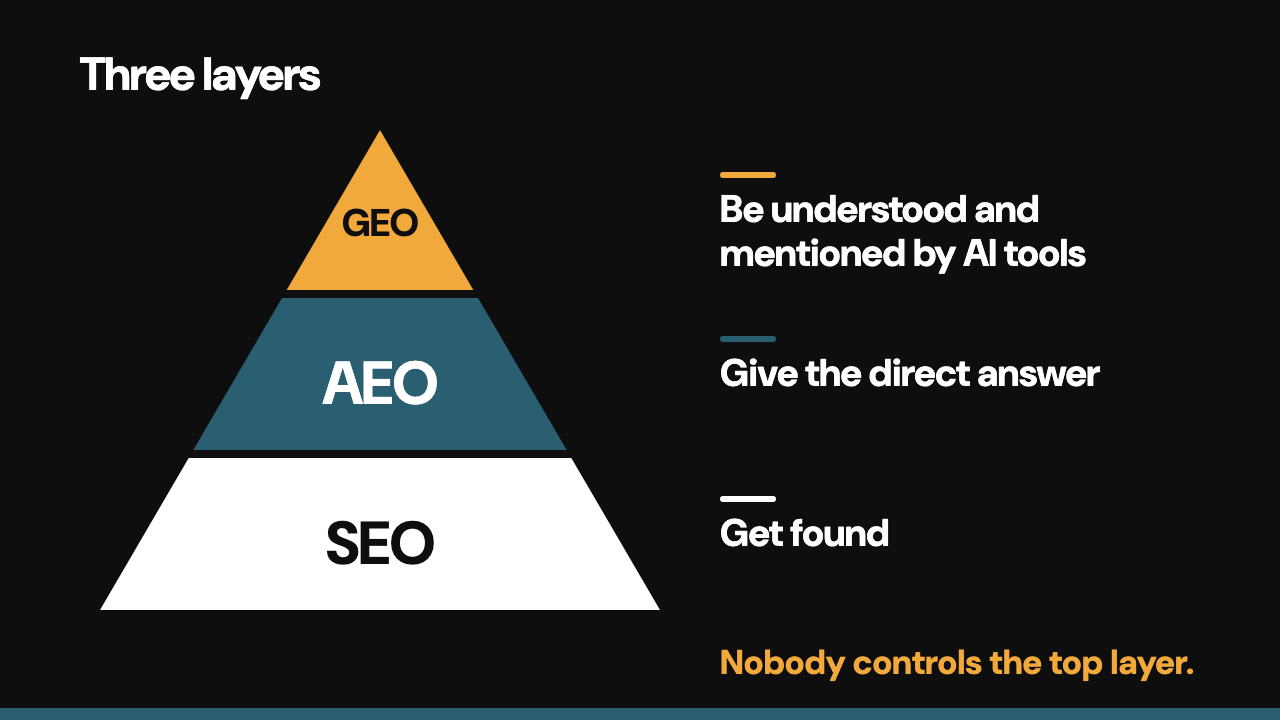
Three letters, three layers.
- SEO (search engine optimisation) gets you found in search results. It is the foundation: clear titles, one main heading per page, a sitemap, pages that load fast.
- AEO (answer engine optimisation) gives the direct answer. You write short, plain answers to the real questions your customers ask, so a search tool or an AI tool can lift the answer.
- GEO (generative engine optimisation) is about being understood and mentioned by AI tools that write their own answers. You say who you are clearly, the same way everywhere, and you make every claim checkable.
Nobody controls the top layer. You can make the first two solid and the third clear.
Why does it matter now?
SparkToro, which studies search behaviour, found that 68.01% of Google searches in the US ended without a click in the first four months of 2026. Its figure covers US searches only. SparkToro says AI answers are likely part of the reason, but the study does not measure how much. It also uses a different data panel from its earlier studies, so be careful comparing it with older numbers.
That does not tell you what will happen to your website. It does explain why people are asking about AI search.
What did I check on my own two sites?
I run two websites, built in two very different ways.
shankyg.com is this site. I wrote it as plain HTML with Claude Code, from a brand document.
GoEast Travels is a travel business I am learning about and growing. It designs trips around wellness, active passions and culture. It runs on WordPress, Elementor and an SEO plugin called Rank Math.
I built GoEast on WordPress because I was new to building websites, and I did not know AI or Claude Code yet. While I was working on it I realised how much more control you get with code. Then I got deeper into Claude and Claude Code, and I could build shankyg.com quickly and cleanly. For my own site I now prefer code: there are no plugins, and I can see and change everything. That is my preference, not a rule. WordPress gives you real things for free, like automatic markup and sitemaps. I have learned both, so I can help people improve a WordPress site as well as build one in code.
Here is what I checked. All figures are from 13 November 2026 unless a date is shown.
| What I checked | shankyg.com (hand-written code) | GoEast Travels (WordPress) |
|---|---|---|
| Home page size | 286 lines of HTML, 2 script tags | 1,456 lines, 50 script tags |
| Main heading (H1) | One on each page I checked | Missing on the FAQ and How we work pages on 27 Oct. Added on 1 Nov |
| Share image | None | None on the home page |
| robots.txt | Lets every crawler in | Blocks only the admin area and names OpenAI's search crawler to allow it |
| Sitemap | One sitemap, 11 pages (7 on 27 Oct) | Four sitemaps (six on 27 Oct, including Elementor template ones, changed 1 Nov) |
| Google Search Console | Sitemap read on 11 Nov, 11 pages found (22 Oct: 7 pages) | Sitemap read on 9 Nov, 44 pages found. An older sitemap index read on 16 Jun listed 46 |
| PageSpeed, mobile | 100 performance, 100 accessibility, 100 best practices, 100 SEO | 92 performance (86 on 27 Oct), 95 accessibility, 100 best practices, 100 SEO |
| FAQ markup | Yes, on the FAQ page | None on the FAQ page |
| Schema validator (27 Oct, not re-run) | No errors or warnings | 0 errors, 0 warnings, 2 items (a header and one Article) |
On PageSpeed, both sites also pass the new Agentic Browsing check (3 of 3). Scores move a little between runs, so treat them as a snapshot.
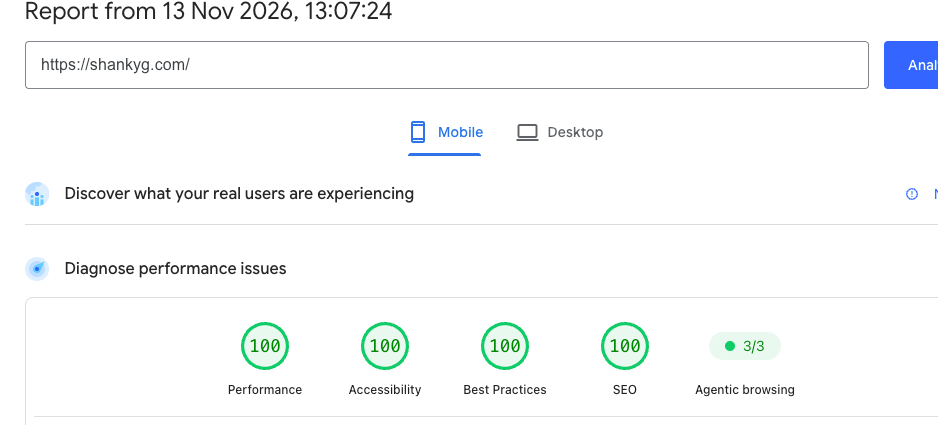
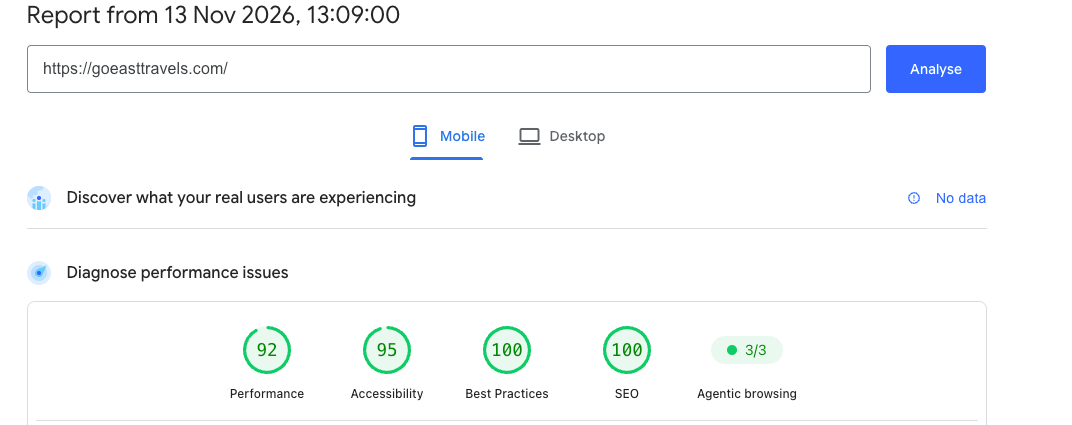
A bigger page is not a worse page. GoEast has far more pages and posts, and the score shows it carries more on every page. The two builds are simply different.
What is llms.txt, and does it work?
llms.txt is a plain text summary of a website, written for AI tools. You will hear people say you must have one.
Mine is short, about 3 KB, and I wrote it myself. GoEast's was generated by the plugin and is about 27 KB. On 13 November, 39 of its 40 entries still begin with the same text, so the descriptions do not describe the pages. Web codes like "&" also sit in the plain text.
So does it work? I do not know, and nobody has shown me proof that it does. I keep mine because it costs me nothing and it is an honest map of my site. If someone tells you llms.txt is the secret to ranking in ChatGPT, they are guessing. And a plugin that writes it for you can fill it with junk.
What did AI tools say when I asked?
I asked four questions on 13 November 2026, on Google (its AI Overview) and on Perplexity. AI answers change from run to run and depend on location, account and time. These are a snapshot, not rankings, and they are kept apart from every other number in this article.
| Question | Where I asked | What came back | Was I mentioned? |
|---|---|---|---|
| How can AI help an independent hotel? | Google AI Overview | A long answer on guest messaging, pricing and back-office work. The sources were vendor and industry pages and one YouTube video | Not in the sources shown |
| What do you look for when recommending an AI consultant for a hotel? | Google AI Overview and Perplexity | Both said much the same: hospitality-specific experience, independence from software vendors and a clear handover plan. Perplexity added a measurable pilot | No |
| Who are good AI consultants for independent hotels? | Google AI Overview and Perplexity | Each named different consultancies and platforms. I am not naming them here | No |
| What do you know about Shanky Gondal? | Perplexity | It found me. It drew on my LinkedIn profile, my website, GoEast and my YouTube channel, and what it said matched my own profiles | Yes |
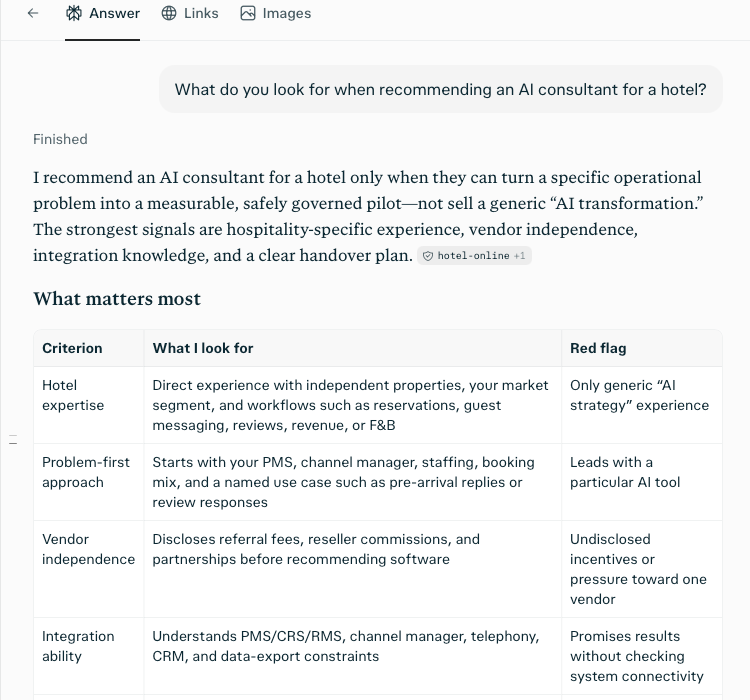
Look at what the tools said they look for: someone who understands hotel operations first and AI second. That is how I describe myself. But when I asked for consultants by category, the tools recommended other people. When I asked by name, they knew who I was. That is the difference between being known and being found.
What did I find wrong, and what have I not fixed yet?
I fixed GoEast's missing headings and trimmed its sitemaps on 1 November. Still open on 13 November: neither home page has a share image, GoEast's FAQ page has no FAQ markup, and its llms.txt descriptions repeat.
I have also not built the slow part on either site: reviews, mentions on other sites and lists. Most guides say AI tools lean on these, and I am not going to fake them.
When the open items are fixed and a few weeks have passed, I will check again and write up what changed, as a separate article, with dated before and after figures.
What can a business owner do this week?
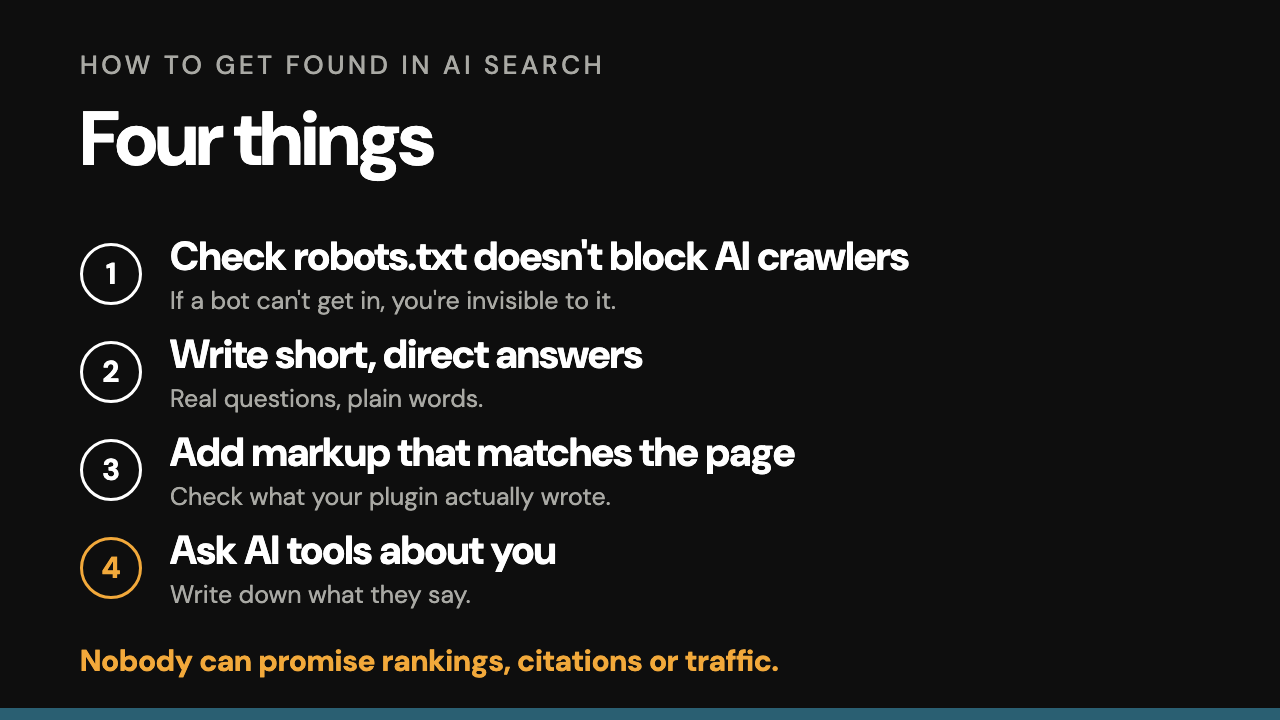
Four things.
- Check that your robots.txt does not block AI crawlers. If a crawler cannot get in, you are invisible to it.
- Write short, direct answers to real questions. Use the questions your customers actually ask, in plain words.
- Add markup that matches the page, and check what your plugin wrote. Do not trust an automatic file until you have read it.
- Ask the AI tools about you, and write down what they say. Note the question, the tool and the date, because answers change.
What can nobody promise?
Rankings, citations and traffic. Nobody can promise any of the three.
The expensive mistake is not skipping GEO. It is paying for a promise while your site still has no clear answers.
Frequently asked questions
What is the difference between SEO, AEO and GEO?
SEO helps people find your website. AEO gives the direct answer to a question. GEO is about AI tools understanding and mentioning your business. They build on each other, and nobody controls the top layer.
Does SEO still matter?
Yes. The checks in this article are the foundation, and they help real visitors as well as machines.
Do I need an llms.txt file?
It is a plain text summary written for AI tools. I could not find proof that it improves AI answers, so I treat it as optional housekeeping.
Can anyone guarantee I will appear in ChatGPT?
No. Be sceptical of any promise like that.
How do I check what AI tools say about my business?
Ask the question a customer would ask, and ask by name. Write down the answer, the tool and the date.
Does this matter for a hotel?
The same basics apply: clear answers on your own site, the same business facts everywhere, and checking what AI says about you. I have not measured any effect on bookings. When I looked on 6 November 2026, the material I found on hotel AI search came from vendors and trade media, not independent studies.
What next?
If you run a hotel or a small business and want to know where AI could actually help, you can read how I work with independent hotels or see my Websites, SEO, AEO and GEO service. When you are ready, book a free AI Opportunity Check. It is a 20 to 30 minute conversation about how your business works and where the opportunities are.