If you have been told a hotel chatbot should answer everything, I think knowing exactly where it stops matters more. A bot that promises a parking space or a suite upgrade it cannot deliver creates more work for the front desk, not less.
I was General Manager of two hotels from 2022 to 2025, and before that Senior Manager, Sales & Guest Experience, from 2017 to 2021, so I know which promises end up back on reception. Below are five guest questions I put to a prototype, including a 2 a.m. arrival and a suite upgrade request, and what the assistant did with each.
You can also watch the full walkthrough: What a Hotel Guest Assistant Does When It Can't Answer (opens in a new tab, 13 minutes 52 seconds).
Why does a hotel chatbot cause trouble when it tries to answer everything?
Think about an independent hotel on an ordinary day. The front desk answers the same questions again and again. The most common ones are the basics: check-in, check-out and breakfast. Every front desk has plenty more.
They are simple questions, but they come in by email, by phone, through booking platforms and at the desk. While the team answers them, the same people are checking guests in, dealing with complaints and talking to housekeeping. Small hotels do not have a separate department for every guest interaction. One person might answer the phone, reply to an email, welcome an arrival and sort out a room problem within the same hour.
The answers to the routine questions already exist in the hotel's own information. Someone still has to pass them on, repeatedly.
That is the case for a guest assistant: a second way for guests to find answers, taking some of the repetition off the front desk. It is not a replacement for reception.
It also shows where a badly set up chatbot hurts. Here is what a promise that goes wrong looks like. At a hotel where I worked, a guest called ahead and was promised parking by a different shift. When he arrived, he said he had been promised a space, and he parked in a no-parking zone. His car was towed. Because the communication had gone wrong between shifts, the hotel ended up paying $400 for the tow the next morning, and it became a big problem.
A chatbot that says "yes, we will hold you a space" makes that same promise to every guest who asks. No one on the next shift knows about it either.
What does the assistant need before it answers a single question?
Before building anything, I had to organise the hotel's information. This part comes before any technology, and most of the real work is here.
I wrote a structured knowledge base for the fictional hotel covering services, policies, facilities and frequently asked questions. Check-in starts at 15:00. Breakfast is served from 07:00 to 10:30. Parking is on site but limited. There is a gym, but no pool and no spa. Those details look basic. They matter because the assistant has to know what the hotel offers and also the limits and conditions attached to it.
Then I wrote rules for how it behaves:
- What can it tell a guest?
- What must it never promise?
- When does it hand over to a person?
- What does it do when it does not have the answer?
If parking is limited, it must not guarantee a space. If there is no pool, it must not invent one. If a guest wants to change a booking, it must not pretend it can see the booking system.
What happened when I put guest questions to it?
The fictional hotel is called Hotel Nord Vale, and the assistant sits on its website. A guest opens it and types a question. Every answer comes from the hotel's own information. These three screenshots are real exchanges with the prototype, with the hotel page behind them hidden.
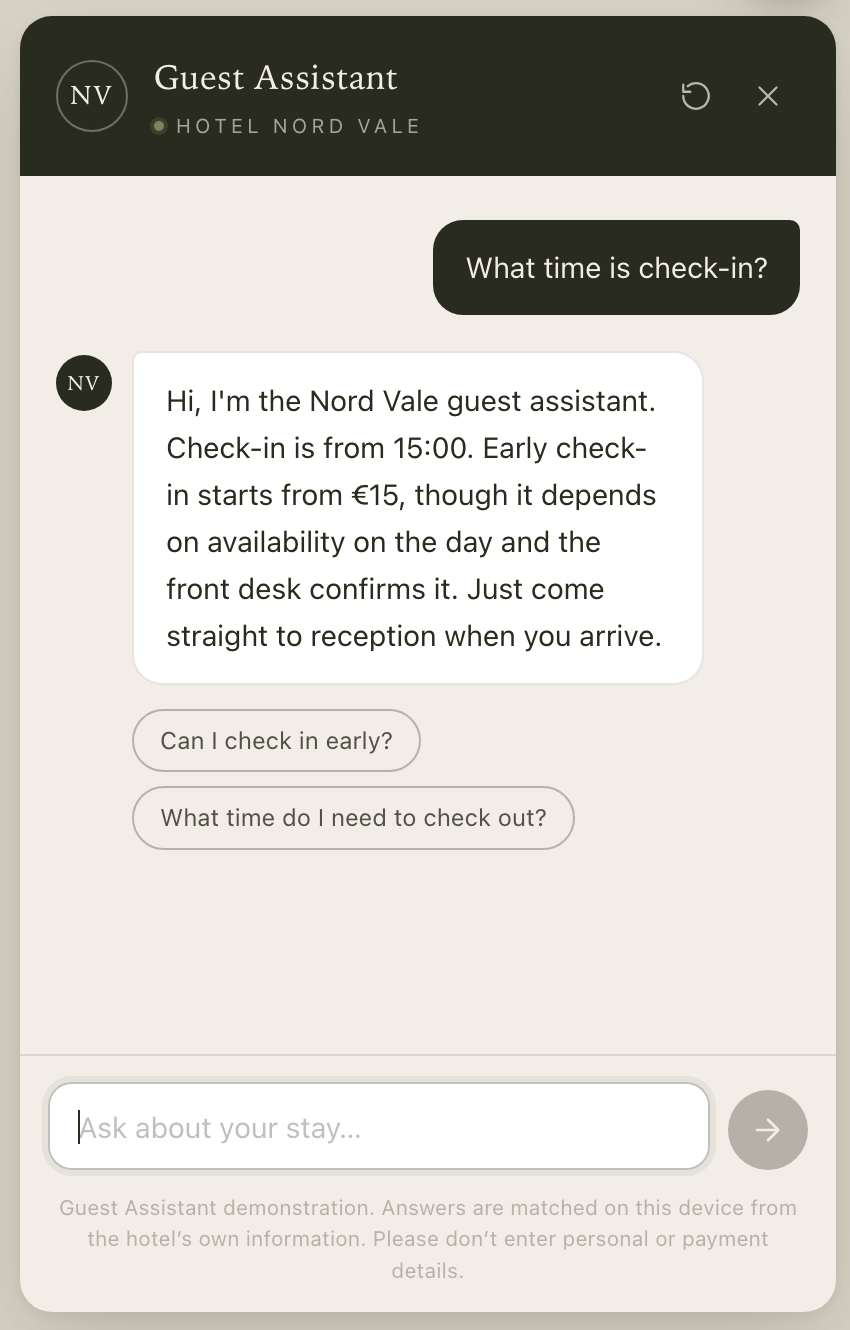
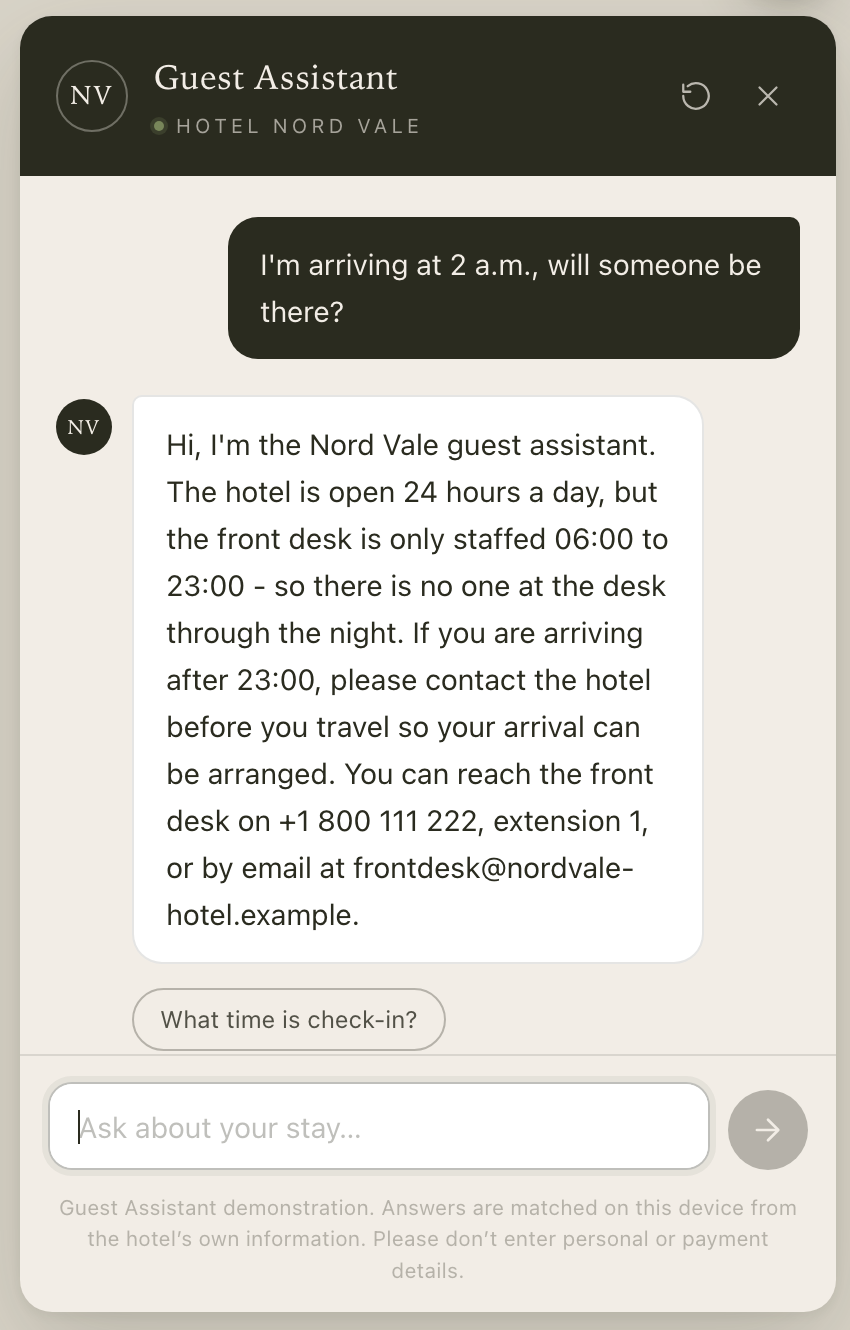
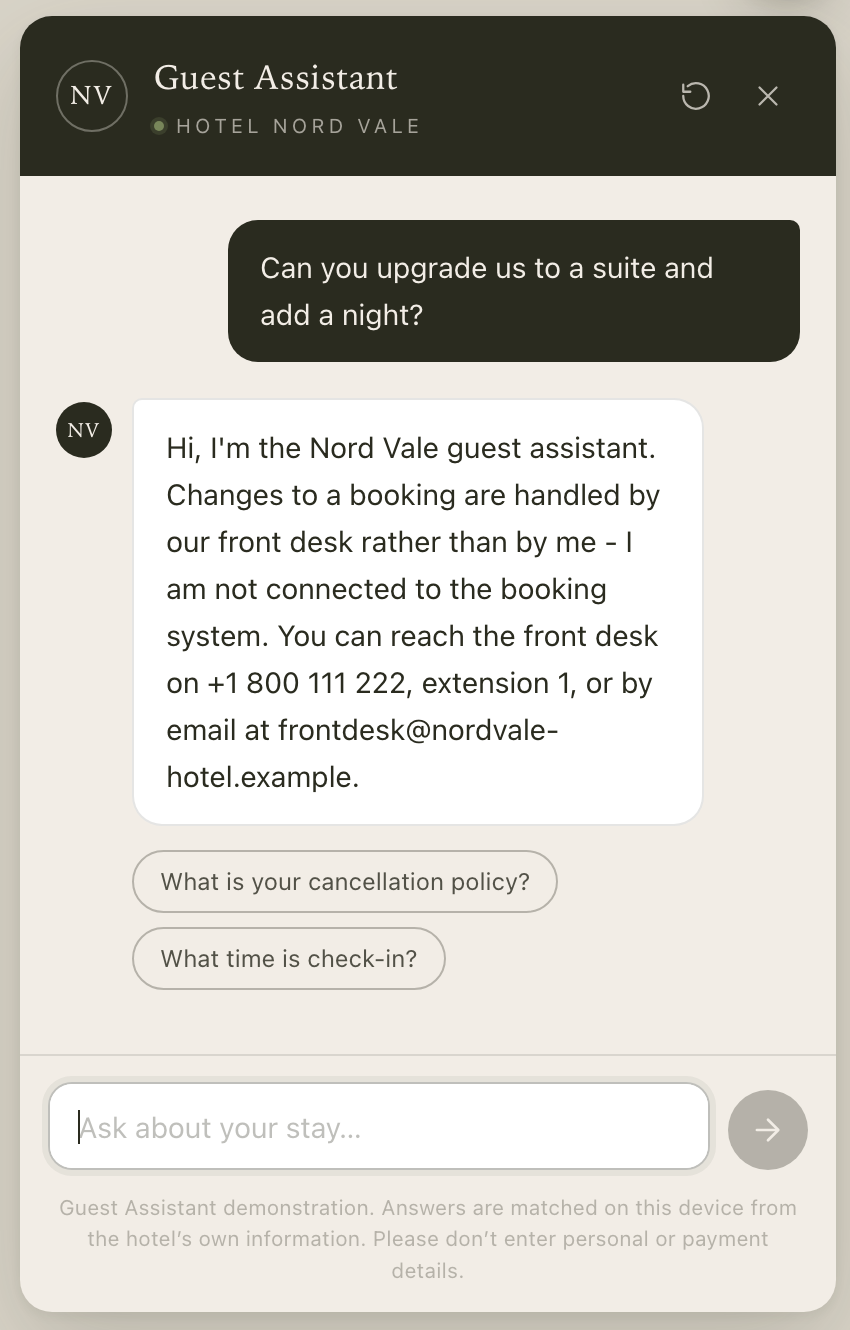
Check-in. It says check-in starts at 15:00 and mentions early check-in. Look at what it does not do. It does not promise an early room. Availability is something the front desk confirms.
A 2 a.m. arrival. This one is more interesting. The hotel is open around the clock, but the front desk is only staffed from 06:00 to 23:00. A generic answer would be wrong here, so the answer has to fit the hotel. The assistant says there is no one at the desk through the night. It tells the guest to contact the hotel before travelling so the arrival can be arranged, and it gives the contact details. It does not imply that a night receptionist exists.
A booking change. Now the test is different. The assistant says it cannot change a reservation, because it is not connected to the booking system, and sends the guest to the front desk. This is what I wanted to show. A good assistant answers what it can, avoids inventing anything and knows when a person has to take over.
Two more questions, which are not in the screenshots:
| Guest question | What the assistant did | Result |
|---|---|---|
| I'm driving tomorrow, do you have parking? | There is parking on site at €12 per night. Spaces are limited and not guaranteed unless reserved, so it tells the guest to contact the front desk to reserve. | Answers, then hands over, and does not promise a space |
| Can I land my private jet? | "I don't have that information available." It gives the front desk number. | Says it does not know, and hands over |
The parking answer is the one I care about most, after that tow. The assistant never says "yes, we have a space for you". The private jet question is a joke, but it tests something real. When the answer is not in the approved information, a good assistant says so instead of improvising.
All amounts are the demo's fictional values. The video goes through the full set of questions.
How does it work, and why is there no live AI model?
For this portfolio project I kept the setup deliberately simple. The hotel's information sits in a structured knowledge base. When a guest sends a question, a local matching engine works out which topic it relates to and picks the answer from the hotel's information. If it cannot match the question with confidence, it gives a fixed fallback response.
There is no live AI model connected to this prototype. It is a local, knowledge-based demonstration, and I chose that on purpose. I wanted to get the guest experience, the structure of the information and the handover rules right before adding complexity.
A real implementation could grow into something that uses an AI model, draws on approved business information and connects to a hotel's existing systems. Which of those makes sense depends on the hotel and the problem you are solving.
The approach is not limited to hotels. Any business has its own information, processes and repeated customer questions. The interface and the information would differ, but the order of work stays the same: understand the business, map how information and requests move through it, find the repetitive tasks, design, build, test on realistic scenarios, and improve based on how it is really used.
What should a hotel check before buying or building a chatbot?
These are the questions I would ask.
- Is your own information up to date? Check your website, your policies and procedures handbook, your checklists and your cheat sheets. Whatever you have, make sure it is all current, because that is the information you are giving the chatbot.
- What is it not allowed to promise? Ask for the list. Parking spaces, early rooms, upgrades and price changes are the usual ones.
- When does it hand over, and to whom? Is there a named person or team, and what are their hours? A hand-over to a front desk that is closed at 2 a.m. is not a hand-over.
- What does it do when it does not know? Ask to see it fail. Try an odd question and read the reply.
- Can it see or change bookings? If it can, find out exactly what it is allowed to change. If it cannot, check it says so, as the prototype does.
- Can you test it on your own real enquiries? Use a week of real emails and calls, not the vendor's examples.
- Where does guest data go? Guests may type personal details. Find out what is stored, where and for how long.
What does this demonstration not prove?
It does not prove any percentage of time or money saved. That would have to be measured in a real hotel, against that hotel's real enquiries. Hotel Nord Vale is fictional, the prototype has no live AI model, and it is not connected to a booking system.
What it does show is where the opportunity sits and what a prototype could be tested against. With a properly built guest assistant, some routine questions could be answered from the hotel's approved information. That could mean fewer repeat enquiries reaching reception, guests getting answers without waiting, and staff with more time for arrivals, for putting things right when a guest is unhappy, and for the situations that genuinely need a person.
Technology should have a business purpose. It should not be added just because AI is popular.
Frequently asked questions
Does the demo use a live AI model?
No. It is a local, knowledge-based prototype that matches each question to the hotel's own information.
Is Hotel Nord Vale a real hotel?
No. It is invented for this demonstration.
Does this show time or money saved?
No. It shows where the opportunity is, and a prototype that could be tested in a real hotel.
What should a hotel chatbot never promise?
Anything only the hotel can decide or deliver: a specific parking space, an early room, an upgrade, a changed booking.
When should a hotel chatbot hand over to a person?
When the request needs a decision, a booking change or personal attention, and when the answer is not in the hotel's approved information.
Can a chatbot change a reservation?
Only if it is connected to the booking system and the hotel allows it. This prototype is not connected, and it says so.
What next?
If you own or manage an independent hotel, or run a business where repeated questions and manual processes eat up your time, I would be happy to look at where technology could help. You can see more on the Demos page (a clearly labelled fictional example), then book a free AI Opportunity Check. It is a 20 to 30 minute conversation about how your business works and where the opportunities are.